The inactivity epidemic research/statistics
https://easo.org/media-portal/statistics/
https://www.who.int/dietphysicalactivity/factsheet_inactivity/en/
"Globally, around 31% of adults aged 15 and over were insufficiently active in 2008 (men 28% and women 34%). Approximately 3.2 million deaths each year are attributable to insufficient physical activity."
"In 2008, prevalence of insufficient physical activity was highest in the WHO Region of the Americas and the Eastern Mediterranean Region. In both these regions, almost 50% of women were insufficiently active, while the prevalence for men was 40% in the Americas and 36% in Eastern Mediterranean. The South East Asian Region showed the lowest percentages (15% for men and 19% for women). In all WHO Regions, men were more active than women, with the biggest difference in prevalence between the two sexes in Eastern Mediterranean. This was also the case in nearly every country."
https://www.who.int/dietphysicalactivity/childhood/en/
"Globally, in 2016 the number of overweight children under the age of five, is estimated to be over 41 million."
"Almost half of all overweight children under 5 lived in Asia and one quarter lived in Africa."
"Overweight and obese children are likely to stay obese into adulthood and more likely to develop noncommunicable diseases like diabetes and cardiovascular diseases at a younger age. Overweight and obesity, as well as their related diseases, are largely preventable. Prevention of childhood obesity therefore needs high priority."
https://www.acefitness.org/education-and-resources/professional/expert-articles/6259/tackling-the-inactivity-epidemic/
"all of this inactivity also increases the risk of developing other chronic diseases like diabetes, osteoporosis and cancer"
"Evidence has shown that physical inactivity is now one of the 10 leading risk factors for death worldwide. This is an alarming statistic and a major reason why we believe this epidemic should be brought to the forefront of public consciousness. It is critical that we draw awareness to the consequences of sedentary behaviours so professionals, individuals, families and communities can take steps to facilitate a cultural shift that makes physical activity an integral part of our country once again."
https://www.pescholar.com/insight/solving-inactivity-epidemic/
"Firstly, physical inactivity can be blamed for between 1.5% and 3.0% of the total direct health care costs in developed countries such as the UK and USA"
"Current estimates by the World Health Organisation suggest that 3.2 million people die around the world each year due to inactivity"
"There are additional impacts on mental health, with prolonged periods of inactivity remaining one of the contributing factors of depression, and other research showing a link between sedentary lifestyles and dementia"
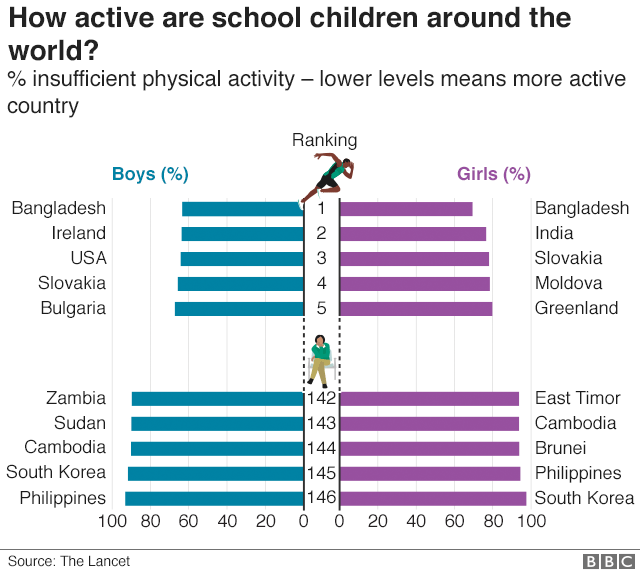
"A study by E.M. Bedale in 1923 revealed that children from that time were 50% more active in comparison to modern children, participating in more than four additional hours of physical activity per day, and spending three hours less sitting down."
https://www.bbc.co.uk/news/health-50466061
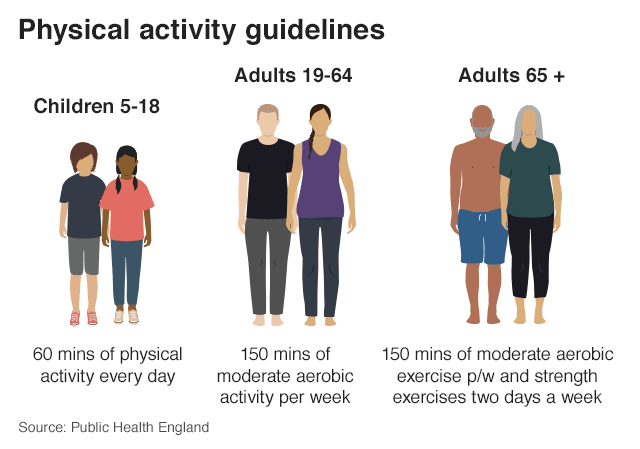
"The target is 60 minutes of moderate-to-vigorous exercise a day."
https://www.who.int/dietphysicalactivity/factsheet_inactivity/en/
"Globally, around 31% of adults aged 15 and over were insufficiently active in 2008 (men 28% and women 34%). Approximately 3.2 million deaths each year are attributable to insufficient physical activity."
"In 2008, prevalence of insufficient physical activity was highest in the WHO Region of the Americas and the Eastern Mediterranean Region. In both these regions, almost 50% of women were insufficiently active, while the prevalence for men was 40% in the Americas and 36% in Eastern Mediterranean. The South East Asian Region showed the lowest percentages (15% for men and 19% for women). In all WHO Regions, men were more active than women, with the biggest difference in prevalence between the two sexes in Eastern Mediterranean. This was also the case in nearly every country."
https://www.who.int/dietphysicalactivity/childhood/en/
"Globally, in 2016 the number of overweight children under the age of five, is estimated to be over 41 million."
"Almost half of all overweight children under 5 lived in Asia and one quarter lived in Africa."
"Overweight and obese children are likely to stay obese into adulthood and more likely to develop noncommunicable diseases like diabetes and cardiovascular diseases at a younger age. Overweight and obesity, as well as their related diseases, are largely preventable. Prevention of childhood obesity therefore needs high priority."
https://www.acefitness.org/education-and-resources/professional/expert-articles/6259/tackling-the-inactivity-epidemic/
"all of this inactivity also increases the risk of developing other chronic diseases like diabetes, osteoporosis and cancer"
"Evidence has shown that physical inactivity is now one of the 10 leading risk factors for death worldwide. This is an alarming statistic and a major reason why we believe this epidemic should be brought to the forefront of public consciousness. It is critical that we draw awareness to the consequences of sedentary behaviours so professionals, individuals, families and communities can take steps to facilitate a cultural shift that makes physical activity an integral part of our country once again."
https://www.pescholar.com/insight/solving-inactivity-epidemic/
"Firstly, physical inactivity can be blamed for between 1.5% and 3.0% of the total direct health care costs in developed countries such as the UK and USA"
"Current estimates by the World Health Organisation suggest that 3.2 million people die around the world each year due to inactivity"
"There are additional impacts on mental health, with prolonged periods of inactivity remaining one of the contributing factors of depression, and other research showing a link between sedentary lifestyles and dementia"
"A study by E.M. Bedale in 1923 revealed that children from that time were 50% more active in comparison to modern children, participating in more than four additional hours of physical activity per day, and spending three hours less sitting down."
https://www.bbc.co.uk/news/health-50466061
"The target is 60 minutes of moderate-to-vigorous exercise a day."
Comments
Post a Comment